

A gas-line problem does not automatically mean the entire line must be replaced. It also does not mean a visible fitting can simply be tightened or patched. The right scope depends on what a licensed plumbing professional finds: where the leak or defect is located, how much piping is affected, whether the remaining line is sound, whether it is properly sized for the connected appliances, and what testing and local requirements apply.
For an Austin homeowner, the useful question is not just “Can this spot be repaired?” It is “Will the proposed work leave the gas system safe, testable, properly sized, and suitable for continued service?” A professional evaluation should connect the recommended scope to observable conditions instead of relying on the pipe’s age or appearance alone.
If You Suspect an Active Gas Leak, Leave First
Treat a gas odor, hissing sound, damaged gas line, or other sign of an active leak as a safety issue. Leave the area immediately. From a safe location, call 911 and your gas utility. Do not smoke, light a flame, operate an electrical switch, start a vehicle near the suspected leak, or return until emergency personnel or the utility says it is safe.
Do not try to find the leak with a match, tighten a fitting, close an unfamiliar valve, or perform a pressure test yourself. Emergency response and utility safety come before scheduling plumbing work. The City of Austin gives the same evacuation-first direction for suspected natural-gas leaks and explains that permit and inspection steps may be required before service is restored.
When a Localized Gas Line Repair May Be Considered
A focused repair may be possible when the problem is isolated and the surrounding piping remains suitable for service. Examples can include a damaged fitting, a leak at one accessible connection, or a short section affected by physical damage while the rest of the line is in acceptable condition.
That decision still requires more than seeing one bad joint. The plumber may need to determine whether the nearby pipe threads are sound, whether corrosion continues beyond the visible area, whether the pipe has adequate support, and whether previous work created another weakness. Access also matters. A fitting that can be reached safely in an open utility area presents a different scope from piping concealed behind finished surfaces or below grade.
A localized repair should address the confirmed defect and allow the completed system to pass the required test. If testing reveals another leak or pressure loss elsewhere, the scope may need to change.
When Broader Replacement May Make More Sense
Replacement of a longer segment—or, in some cases, a larger portion of the line—may be recommended when the problem is not isolated. Widespread corrosion, repeated leaks, multiple questionable connections, severe physical damage, or piping that cannot be tested successfully can point beyond a one-spot repair.
The existing line may also be unsuitable for a planned appliance. A new range, dryer, fireplace, tankless water heater, generator, or outdoor appliance can change the gas demand on the system. A line that served the old equipment may not have the capacity, routing, material, or connection needed for the new installation. Replacing or rerouting part of the system may be the practical way to provide an appropriate supply path.
Access can influence the recommendation too. If several worn connections are concealed along the same difficult route, repeated opening and patching may create more disruption than replacing an accessible segment in one planned scope. The plumber should explain that tradeoff rather than treating replacement as automatic.
Six Findings That Shape the Recommendation
Leak Location and Extent
An accessible leak at one threaded joint may support a different plan from pressure loss with no visible source. The evaluation should identify whether the issue is at an appliance connector, valve, fitting, branch line, yard line, or another part of the gas system. When the source is uncertain, additional diagnostic work may be needed before a repair price or replacement scope can be final.
Pipe and Fitting Condition
Surface discoloration alone does not establish the condition of the whole line. A plumber looks for deeper corrosion, damaged threads, movement, inadequate support, incompatible materials, and signs of earlier repairs. The condition immediately beside the failed area matters because a new fitting cannot create a reliable connection if the remaining pipe is too deteriorated to reuse.
Pressure-Test Results
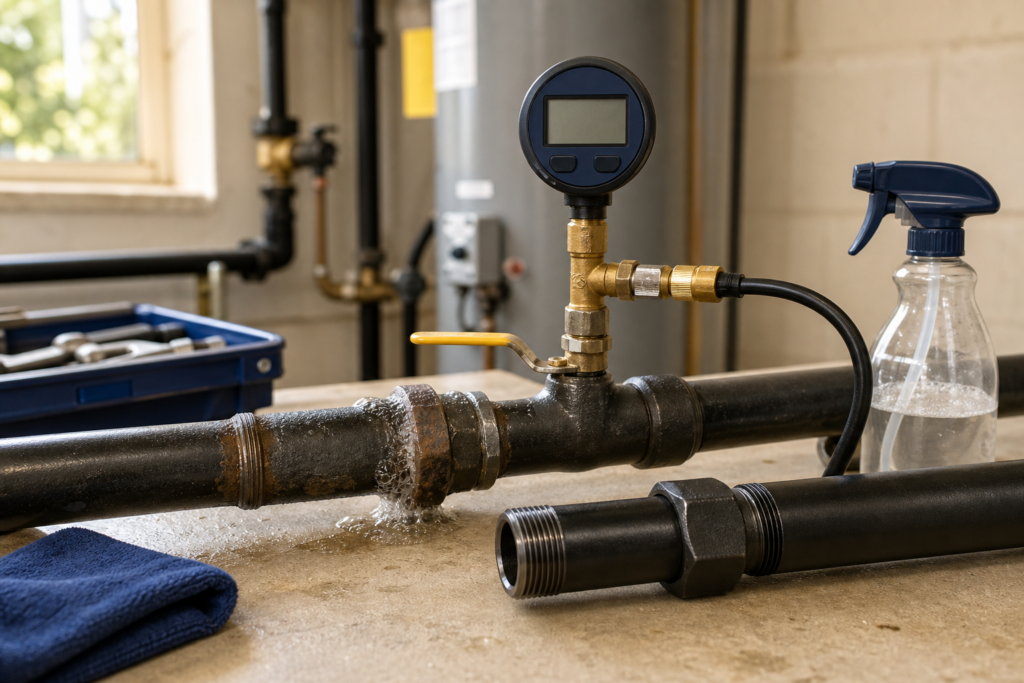
Pressure testing helps determine whether the system holds under the required test conditions after work is completed. A failed test can reveal that the visible problem was not the only problem. The test method, pressure, duration, isolation steps, and documentation must follow the requirements that apply to the project; these are not appropriate do-it-yourself tasks.
Ask whether the quoted scope includes the necessary test, what happens if another leak appears, and how a revised recommendation would be approved.
Appliance Demand and Line Sizing
Gas piping must be appropriate for the appliances it serves. The plumber may review the connected appliance ratings, the length and routing of the run, pipe diameter, branches, and planned equipment changes. Poor appliance performance does not prove that the pipe is undersized, but sizing is one condition worth checking when a new appliance is added or an existing appliance does not receive an adequate supply.
If you are planning a tankless water heater installation or another high-demand appliance, share the exact model information before the gas-line scope is finalized.
Access and Restoration Needs
Gas piping may run through an attic, wall, crawlspace, utility area, exterior wall, or underground route. The repair decision should account for safe access and for any surfaces that must be opened. Ask what access work is included, what restoration is excluded, and whether another trade will be needed after the plumbing work.
Permit, Inspection, and Utility Requirements
Natural-gas work is regulated through plumbing requirements. City of Austin guidance explains that gas work may require a plumbing permit and inspection, and that a meter shutoff can trigger specific steps before utility service is restored. Requirements can vary with the address, jurisdiction, and scope, so the plumber should confirm what applies to your project.
Permit and inspection needs are part of planning, not evidence that every repair must become a full replacement. They help define how the work must be completed, tested, documented, and approved.
How to Compare a Repair Scope With a Replacement Scope
Two estimates may not be describing the same work. Compare the actual responsibilities rather than the total alone. A clear proposal should identify:
- The confirmed problem or condition being addressed
- The exact section of piping, fittings, valves, or connections included
- Whether the work is a localized repair, segment replacement, reroute, or larger replacement
- The material and general route proposed
- Appliance connections included or excluded
- Required pressure testing
- Permit, inspection, and utility coordination responsibilities
- Access, excavation, wall opening, patching, and cleanup boundaries
- Conditions that could require a revised scope
- How additional work would be documented and approved
Ask why the plumber expects the recommended option to address the confirmed condition. If both repair and replacement are viable, ask what risk, access, service-life, or future-appliance tradeoff separates them. If only one option is recommended, ask which finding rules out the narrower alternative.
Questions to Ask Before Authorizing Gas Line Work
Bring the conversation back to the diagnosis with direct questions:
- Where is the confirmed leak, defect, or capacity concern?
- How was that condition identified?
- Is the surrounding piping suitable to reconnect and test?
- Does the line properly serve the current and planned appliances?
- What portion of the gas system is included in the scope?
- What testing is included after the work?
- Does the project require a permit, inspection, or utility coordination?
- What access or restoration work is included and excluded?
- What findings could change a repair into a broader replacement?
- How will a scope change be explained and approved?
You should be able to describe what is being repaired or replaced, why that scope was recommended, and what must happen before the system returns to service.
Prepare for a Professional Evaluation
If there is no active leak or emergency condition, gather information that can help the plumber understand the system. Note which appliance or area is involved, when the symptom began, and whether any appliance or remodeling work was recently completed. Keep appliance model information and prior gas-line records available if you have them.
Clear ordinary stored items away from the accessible work area only when it is safe. Do not remove walls, dig around a buried line, disconnect an appliance, or disturb suspected gas piping. If the utility or emergency responders have shut off service, leave it off and follow their instructions.
Get Help With a Gas Line Decision in Austin
Abundant Plumbing provides gas line repair and replacement in Austin, including evaluation of the appliance, line location, access, code requirements, and pressure testing where required. Call (512) 201-9978 or request service online to discuss the condition you have noticed and arrange a professional assessment.